
Commercial Truck Fiberglass Restoration: The Professional Guide to Heavy-Duty Repair
- Alina Rikli
- 5 days ago
- 11 min read

Why pay for a full hood replacement when a structural restoration can return your vehicle to factory standards at a fraction of the cost? For fleet managers, the sight of a cracked fiberglass panel often triggers immediate concerns about mounting expenses and extended vehicle downtime. You need your assets on the road, not sitting in a lot waiting for expensive OEM parts that might take weeks to arrive. It's often difficult to find a shop that claims to handle heavy-duty work but actually possesses the bay space for a coach or a high-roof van.
Professional commercial truck fiberglass restoration offers a reliable alternative that prioritizes both your budget and your vehicle's structural integrity. This guide explains how expert repairs save your fleet significant time and money while ensuring every component looks and performs like new. We will examine the specialized techniques used for heavy-duty vehicles, the necessity of purpose-built facilities for oversized trucks, and the methodical process required to get your drivers back behind the wheel safely and quickly.
Table of Contents
What is Commercial Truck Fiberglass Restoration?
Commercial truck fiberglass restoration is a specialized engineering process designed to return heavy-duty vehicle components to their original strength and profile. It is not a simple cosmetic touch-up. While a standard body shop might use filler to hide a crack, professional restoration involves rebuilding the laminate layers of the material. This ensures that a hood, fairing, or air deflector can withstand the intense wind resistance and constant vibration inherent in long-haul trucking. A safe, professional approach relies on proven composite repair techniques to ensure the chemical bond between the old and new material is permanent and structurally sound.
Choosing restoration over a quick patch is a pragmatic decision for any fleet manager. A simple patch often fails because it doesn't flex at the same rate as the surrounding fiberglass. Eventually, the vibration of a heavy diesel engine causes the patch to pop out or the crack to reappear. Professional commercial truck fiberglass restoration grinds away the damaged area entirely, creating a tapered edge that allows for a seamless, high-strength bond. This methodical approach stops damage from spreading and prevents the need for a total component replacement later.
The Role of Fiberglass in Heavy-Duty Vehicles
Manufacturers prioritize fiberglass for hoods and side panels because of its high strength-to-weight ratio. A lighter truck carries more cargo and burns less fuel, which is vital for maintaining margins. Because these components are molded, they offer superior aerodynamics that traditional sheet metal can't easily replicate. Additionally, fiberglass is naturally resistant to corrosion. This makes it an ideal material for fleets operating in the DMV area, where road salt and high humidity often accelerate the decay of metal parts. A fiberglass semi-truck hood typically has a lifespan of 8 to 15 years, but achieving that full lifespan requires expert care when damage occurs.
Common Types of Fiberglass Damage
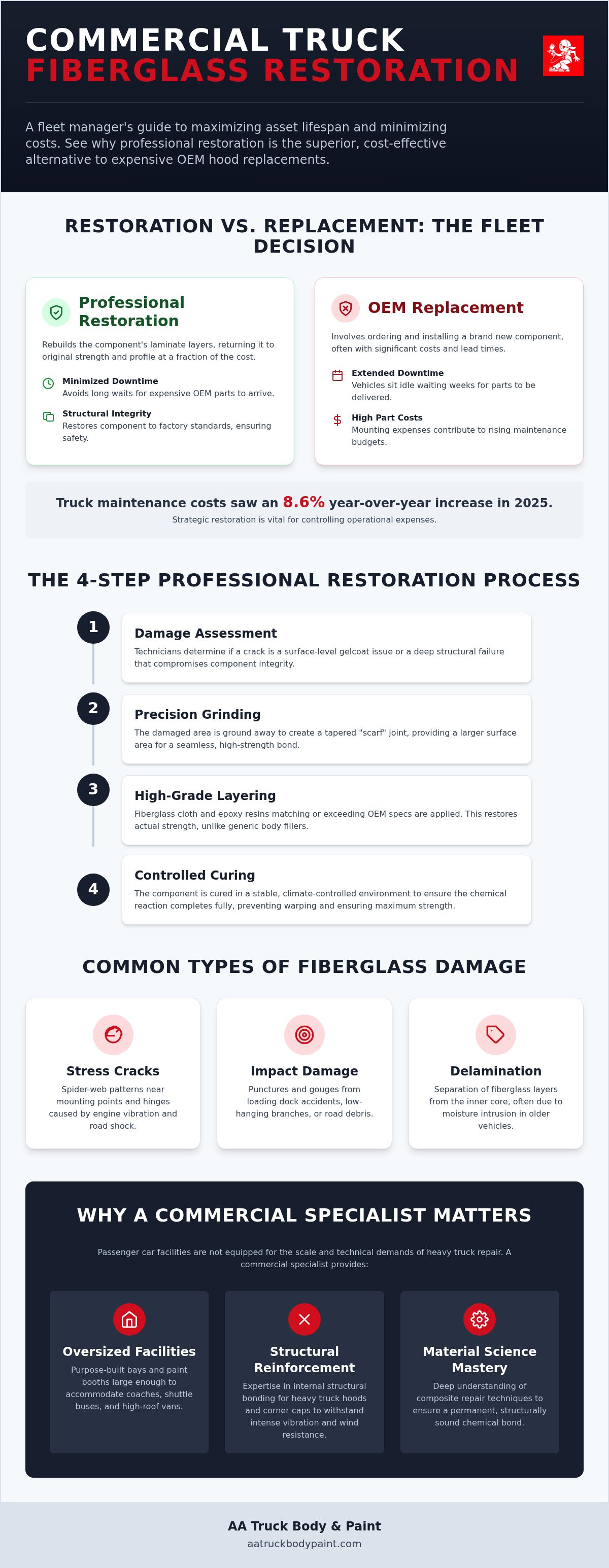
Understanding the root cause of damage is the first step in a successful repair. Most issues in a commercial fleet fall into three categories:
Stress Cracks: These spider-web patterns often appear near mounting points or hinges. They're caused by engine vibration and road shock.
Impact Damage: This includes punctures or gouges from loading dock accidents, low-hanging branches, or road debris kicked up on the highway.
Delamination: Common in older RVs and coach buses, this happens when the fiberglass layers separate from the inner core, often due to moisture intrusion.
With truck maintenance costs seeing an 8.6% year-over-year increase in 2025, commercial truck fiberglass restoration has become a vital strategy for controlling operational expenses. It allows fleets to maintain a professional appearance and structural safety without the high cost of new OEM parts.
The Professional Fiberglass Restoration Process
A successful repair begins with a rigorous assessment of the damage. Technicians must determine if a crack is merely a surface-level gelcoat issue or a deep structural failure that compromises the component's integrity. For heavy-duty vehicles, a compromised hood can flex excessively under wind pressure, leading to catastrophic failure at highway speeds. We adhere to composites industry best practices by stripping back damaged areas to healthy material before any new resin is applied. This involves precision grinding to create a tapered "scarf" joint, which provides a larger surface area for the new laminate to bond with the original structure.
The layering phase requires technical mastery and an understanding of material science. We use high-grade fiberglass cloth and epoxy resins that match or exceed the original manufacturer's specifications. Unlike generic body fillers, these materials restore the actual strength of the panel. Proper curing is the most overlooked step in many shops. Heavy-duty components require stable, climate-controlled environments to ensure the chemical reaction between the resin and hardener completes fully without warping the panel. If you need a reliable partner for commercial truck fiberglass restoration, choosing a shop that respects these technical requirements is essential.
Structural Reinforcement Techniques
For significant punctures or large cracks, we employ backing materials to create a solid foundation for the new layers. This prevents resin leakage and ensures the final repair has the uniform thickness required for structural stability. We pay close attention to internal structural bonding for heavy-truck hoods and corner caps, where stress is highest. 'Wet out' is the critical phase where the fiberglass cloth is completely saturated with resin to eliminate air pockets that cause delamination. This methodical approach ensures the repair becomes a permanent part of the vehicle rather than a temporary patch.
Precision Surface Finishing
Once the structural repair is fully cured, the focus shifts to the aesthetic and aerodynamic profile. We apply specialized fiberglass fillers to eliminate low spots and restore the original contours of the vehicle. Precision sanding is a mandatory requirement for aerodynamic performance. Even minor surface irregularities can increase wind resistance, which impacts fuel efficiency over thousands of miles. Our technicians use progressively finer grits to achieve a seamless factory-grade profile. The final step involves applying a high-build commercial primer and sealant, creating a perfect foundation for heavy-truck hood painting that stands up to the harsh conditions of the road.
Restoration vs. Replacement: Making the Right Fleet Decision
Determining whether to repair or replace a damaged fiberglass component is a critical decision for fleet managers. It's a balance between upfront costs, long-term durability, and the immediate need to minimize downtime. While a total replacement might seem like the simplest route, it's often the most expensive and time-consuming option. A professional commercial truck fiberglass restoration can return a panel to its original structural integrity while saving significant capital that would otherwise be spent on new parts and oversized freight shipping.
Structural failure doesn't always necessitate a new part. By following industry-leading protocols, such as 3M's standard operating procedures for heavy-duty truck repair, technicians can rebuild the composite matrix of the fiberglass. This ensures the restored panel can handle the same aerodynamic loads and engine vibrations as a brand-new component. However, if the damage includes widespread shattering or compromises the primary mounting points beyond any viable repair, a full replacement becomes the only safe path forward for the fleet.
Cost-Benefit Analysis for Fleet Managers
The financial impact of restoration is substantial. Sourcing a new OEM hood for a heavy-duty truck often costs between $3,000 and $6,500 or more. Choosing restoration typically reduces these costs by 50% or more. Insurance adjusters frequently favor restoration for this reason, as it provides a high-quality result while staying within reasonable claim limits. Beyond the immediate invoice, professional repairs protect your asset's resale value by maintaining a factory-standard appearance and ensuring the vehicle remains roadworthy for its full operational life.
Downtime Considerations
Downtime is the hidden killer of fleet profitability. Ordering a new fiberglass hood for a specialized coach bus or an older heavy truck often involves long lead times. In many cases, these parts are backordered or even discontinued, leaving your vehicle idle for weeks. A specialized shop performing commercial truck fiberglass restoration can often complete the work in a fraction of the time it takes for a new part to arrive. This gets your drivers back on DMV roads faster, ensuring your revenue isn't lost to a vehicle sitting in a lot. Specialized facilities streamline the timeline by handling everything from structural bonding to heavy-truck hood painting in-house.
Specialized Restoration for Oversized and Fleet Vehicles
Oversized vehicles present logistical and technical hurdles that standard body shops simply aren't equipped to handle. When dealing with a coach bus or a Class A motorhome, the sheer scale of the fiberglass panels requires specialized scaffolding and high-clearance bays. A facility must be able to accommodate the height of a high-roof Sprinter or the width of a shuttle bus to perform effective commercial truck fiberglass restoration. Without this dedicated space, repairs are often rushed or incomplete, leading to structural weak points that fail under the stress of daily operations.
RV and Motorhome Exterior Restoration
Managing large-scale vertical fiberglass panels on a motorhome is a high-stakes task. In the Virginia climate, sun exposure often leads to significant gelcoat oxidation and fading. We focus on restoring the original luster while ensuring the structural bond remains intact. Water-tight integrity is our priority during any panel repair. Even a hairline crack in a motorhome's fiberglass shell can allow moisture to seep into the insulation, causing mold and rot that can devalue the asset by thousands of dollars. We use marine-grade resins to ensure every seal is impervious to the elements.
Coach and Shuttle Bus Body Repair
Transit and shuttle fleets face unique pressures because their appearance directly impacts passenger confidence. Impact damage on passenger-facing surfaces must be addressed with a focus on both safety and aesthetics. For fleet managers seeking a Coach Bus Body Shop in Virginia: Professional Collision & Paint Reference, it's vital to find a partner who understands the structural fiberglass needs of these vehicles. We restore everything from minor gouges to major structural failures in bus bodies, ensuring the vehicle meets all safety standards before returning to service.
High-roof transit vans and box trucks often suffer from overhead impact damage. Box truck corner caps are particularly vulnerable to low-hanging branches and tight loading docks. Because these caps are often molded as single pieces, they require precise commercial truck fiberglass restoration to maintain the aerodynamic profile of the truck. If your fleet includes high-roof vans or specialized coaches, our team provides the expert fiberglass repair services needed to keep your vehicles in top condition.
Choosing a Commercial Specialist in the DMV Area
Selecting the right shop for commercial truck fiberglass restoration is a decision that directly impacts your fleet's bottom line and long-term safety. Most passenger car body shops simply don't have the infrastructure or the specialized knowledge to handle heavy-duty assets. Their equipment is scaled for sedans and SUVs, not 45-foot coaches or high-roof delivery vans. A true commercial specialist understands that these vehicles aren't just transport; they're revenue-generating tools that require industrial-grade resins and climate-controlled facilities to return to service correctly.
Facility Requirements for Oversized Vehicles
Oversized vehicles require high-clearance bays and specialized heavy-truck equipment that standard shops lack. Professional restoration requires more than just physical space; it needs a climate-controlled environment to be successful. Fiberglass resins and catalysts are extremely sensitive to shifts in temperature and humidity. If the environment isn't strictly managed, the chemical bond may fail, leading to premature cracking or delamination. AA Truck Body & Paint maintains a specialized facility designed specifically for these high-stakes repairs. By excluding passenger car repairs, we ensure our technicians and equipment stay focused on the precision required for heavy-duty commercial work. This specialization allows us to maintain the highest standards for structural integrity and aerodynamic finishing.
The AA Truck Professional Ally Approach
We position ourselves as a pragmatic ally to fleet managers across Maryland, Virginia, and the DC corridor. Our 30+ years of industry experience have taught us that honesty and efficiency are what matter most to a busy professional. When you bring a vehicle to us, you get a straight-shooter assessment every time. We focus on reducing downtime by identifying the most durable, cost-effective path for your commercial truck fiberglass restoration. We understand that every day your truck is in the shop is a day it isn't earning revenue.
Our final quality control process includes precision paint matching for heavy-truck hoods and panels. We use commercial-grade coatings that stand up to the rigors of the road while ensuring your vehicle looks brand new. Whether you're managing a fleet of shuttle buses or a single heavy-duty truck, you need a safe pair of hands. We provide the stability and technical mastery required to get your assets back on the road with total confidence.
Protect Your Fleet Assets with Expert Fiberglass Repair
Choosing professional commercial truck fiberglass restoration is a pragmatic investment in your fleet's longevity and operational efficiency. By prioritizing structural rebuilding over simple cosmetic patches, you ensure your heavy-duty vehicles remain safe and aerodynamic on the road. We've discussed how specialized facilities and technical mastery prevent unnecessary downtime while avoiding the high costs of OEM hood replacements. Professional restoration maintains the durability your business depends on every day.
At AA Truck Body & Paint, we bring 30+ years of industry experience to every project. Our specialized facility is specifically designed for oversized vehicles, ensuring we can handle coaches, shuttle buses, and high-roof vans with precision. We serve commercial fleets throughout the DMV area with the stability and craftsmanship required for high-stakes repairs. You can trust our team to provide a safe pair of hands for your most valuable equipment.
Get a Professional Estimate for Your Commercial Fiberglass Repair and see how our straight-shooter approach can save your business time and money. We look forward to helping you keep your vehicles road-ready and professional for years to come.
Frequently Asked Questions
Can a cracked fiberglass truck hood be safely repaired?
Yes, most cracked fiberglass hoods can be safely restored to their original structural integrity. Professional repair involves more than just filling a surface crack; it requires grinding back damaged fibers and rebuilding the laminate with high-grade resin and cloth. This process ensures the hood can withstand the high wind resistance and engine vibrations experienced on the road. We assess each component to confirm that the mounting points and core structure remain viable for a safe, permanent repair.
How long does a typical commercial truck fiberglass restoration take?
The timeline for commercial truck fiberglass restoration varies based on the severity of the damage and the curing requirements for the specific resins used. Minor structural repairs can often be completed in a few business days. This is typically much faster than waiting weeks for backordered OEM hoods or oversized panels to arrive. Our goal is to minimize your fleet's downtime by performing all structural bonding and precision painting in our specialized DMV facility.
Is restored fiberglass as strong as the original factory panel?
When performed by experienced technicians, a restored fiberglass panel meets or exceeds factory strength standards. We use high-quality resins and layering techniques that rebuild the composite matrix of the material. This ensures the repaired section flexes and handles stress at the same rate as the surrounding area. Unlike a simple patch, a professional structural restoration prevents the crack from reappearing due to the constant road shock and vibration inherent in heavy-duty trucking.
What is the cost difference between fiberglass restoration and replacement?
Restoration is significantly more cost-effective than purchasing a full replacement component. New OEM semi-truck hoods often represent a major capital expense, especially when you factor in the high costs of shipping oversized parts. Restoration typically allows fleet managers to return a vehicle to service for a fraction of the replacement price. This pragmatic approach saves your business money while maintaining a professional appearance and structural safety for your heavy-duty assets in the Maryland and Virginia area.
Do you provide fiberglass repair for RVs and motorhomes in the DMV?
Yes, we specialize in fiberglass repair for RVs, motorhomes, and other oversized recreational vehicles throughout Maryland, Virginia, and DC. Our facility features high-clearance bays designed specifically to accommodate large-scale transport that standard shops cannot fit. We address common RV issues like delamination, vertical panel cracks, and impact damage. Our team ensures that every repair is water-tight and aesthetically seamless, protecting the long-term value of your motorhome investment.
Can you match the custom paint color of my commercial fleet during restoration?
Precision color matching is a standard part of our restoration process. We understand that fleet branding is essential for your business's professional image. Our technicians use advanced paint-matching technology to ensure that the restored fiberglass component perfectly aligns with your existing fleet colors. Whether we're performing heavy-truck hood painting or repairing a shuttle bus, the final finish will be indistinguishable from the original factory paint, even on older vehicles with slight sun fading.
Why shouldn't I take my commercial truck to a standard passenger car body shop?
Standard passenger car shops lack the specialized equipment and high-clearance bays required for heavy-duty vehicles. Their facilities are scaled for sedans, not 45-foot coaches or high-roof vans. Additionally, commercial truck fiberglass restoration requires industrial-grade resins and curing environments that aren't typically used in automotive repair. By focusing exclusively on commercial and oversized vehicles, we provide the technical mastery and specific facility requirements needed to ensure a safe, durable repair that meets heavy-duty operational demands.
What types of fiberglass damage are most common for box trucks?
Box trucks frequently suffer from impact damage to corner caps and roof edges due to low-hanging branches or tight loading docks. These areas are vulnerable because they are often the highest points of the vehicle. We also see significant stress cracking around hinges and mounting hardware caused by constant vibration. Our team provides specialized box truck panel repair to address these issues, ensuring the structural integrity of the cargo area remains intact while maintaining an aerodynamic and professional exterior.


Comments